An Adaptive Ensemble Machine Learning Classifier for Sentiment Analysis on Twitter
DOI:
https://doi.org/10.37934/ard.136.1.340357Keywords:
Sentiment analysis, ensemble classifier, feature extraction, LDA, TF-IDF, SVM, NB, RF, DT, voting, bagging, XGBoost and stackingAbstract
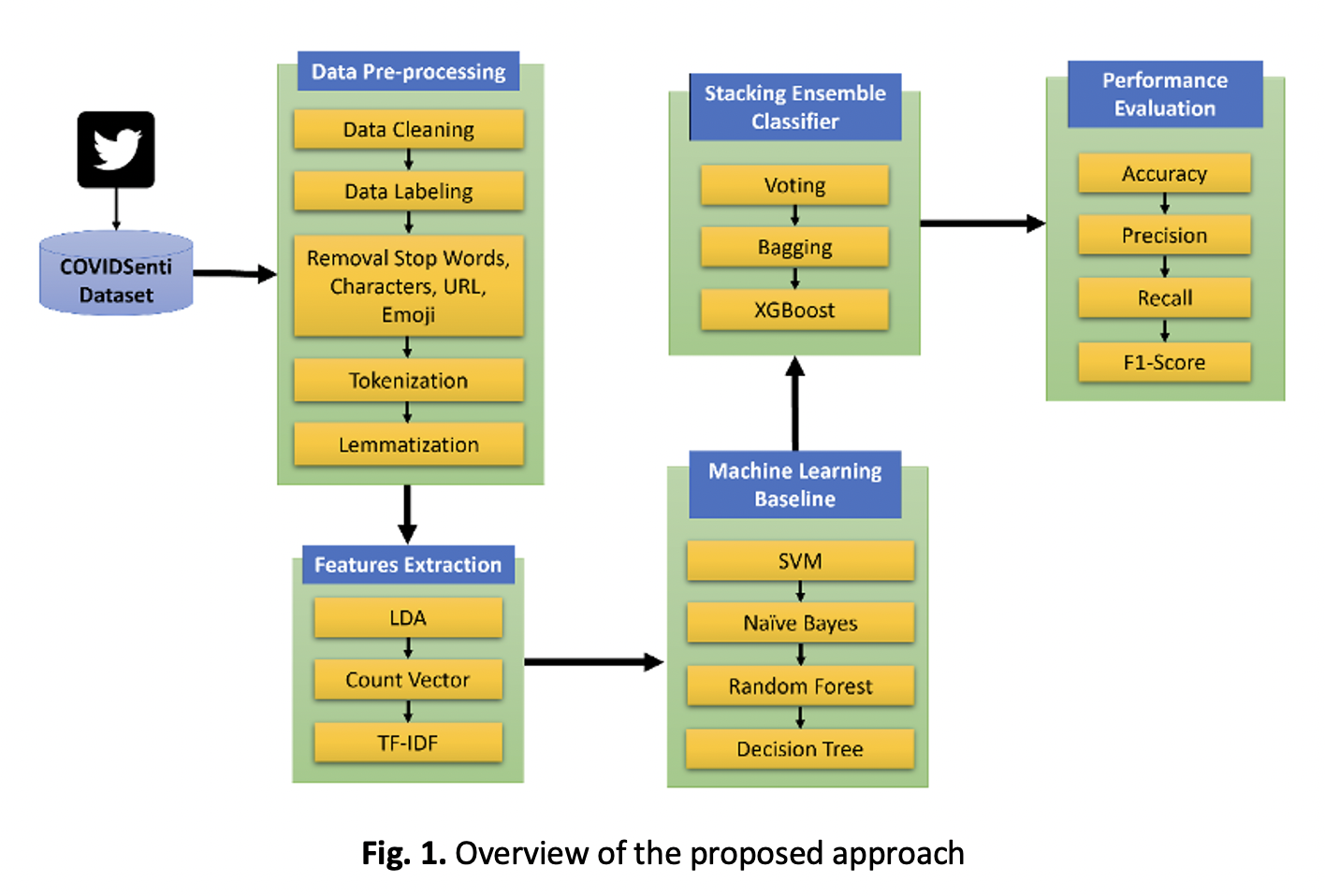
Social media platforms serve as ubiquitous channels for individuals to connect, communicate, and share information in real-time across the globe. The exponential growth of social media platforms, particularly Twitter, has led to a significant increase in textual data, shaping social discourse and sentiment analysis. This abundance of data presents challenges and opportunities for understanding the dynamics of social media interactions and sentiment expression. Sentiment analysis faces challenges: sparse data limits understanding, while topic coherence and interpretability demand improvement for clearer insights. The primary goal of this paper is to improve the accuracy and effectiveness of sentiment analysis through the application of advanced techniques and classifiers. Traditional machine learning techniques often struggle to effectively capture the nuanced sentiment expressed in tweets. To address this issue, we propose a novel ensemble learning framework that dynamically adapts to the evolving characteristics of Twitter data. We experiment with baseline classifiers such as Support Vector Machines (SVM), Random Forest (RF), Decision Tree (DT), and Naive Bayes (NB) on Twitter data. Our approach combines these weak learners through ensemble methods like Voting, Bagging, XGBoost, and stacking, incorporating a meta-learner to optimize prediction performance. The experimental findings demonstrate that our innovative ensemble classifier achieves a remarkable accuracy rate, significantly surpassing that of individual classifiers. This paper contributes to the advancement of sentiment analysis techniques tailored for social media data, offering insights into the potential of adaptive ensemble learning in addressing the unique challenges posed by Twitter sentiment analysis.Downloads
Download data is not yet available.
Downloads
Published
2026-01-15
How to Cite
Mohd Sofi, S. ., Selamat, A. ., & Shaffiei, Z. A. . (2026). An Adaptive Ensemble Machine Learning Classifier for Sentiment Analysis on Twitter. Journal of Advanced Research Design, 136(1), 340–357. https://doi.org/10.37934/ard.136.1.340357
Issue
Section
Articles