Evaluating the Usability of a Marker-Based Augmented Reality Application for Electronics Learning in Secondary Education
Keywords:
STEM education, Augmented reality, Electronics learning, Microcontroller learningAbstract
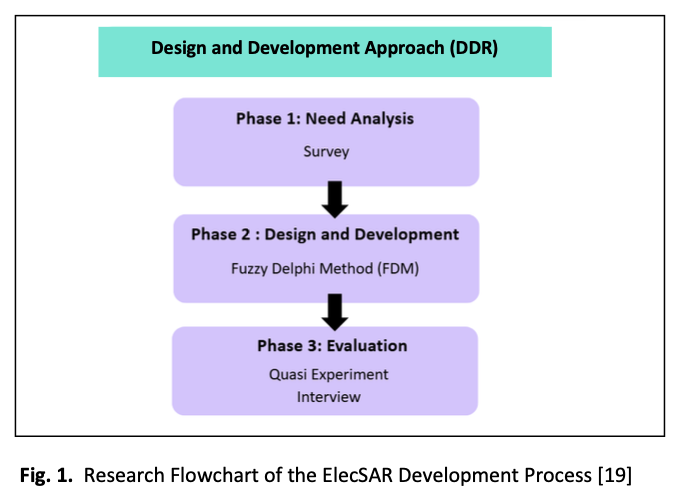
The integration of marker-based Augmented Reality (AR) in STEM education has received growing scholarly attention because of its capacity to visualise abstract concepts and facilitate interactive learning. However, many existing AR tools continue to present usability challenges, inconsistencies in interaction design, and limited alignment with learners’ cognitive needs. These issues affect their effectiveness in actual classroom contexts. This study evaluates the usability of ElecSAR, a marker-based AR application developed to support secondary school students in learning electronic circuits through interactive 3D visualisation and guided simulation. The development of ElecSAR followed a Design and Development Research approach that included needs analysis, expert validation using the Fuzzy Delphi Method, and iterative prototyping. A usability investigation was conducted with secondary school students (N = 34) through 5 weeks implementation, and evaluated using a questionnaire based on the four constructs of the Technology Acceptance Model (TAM). The findings indicate consistently high user ratings for Perceived Usefulness (M = 4.66, SD = 0.51), Perceived Ease of Use (M = 4.61, SD = 0.48), Attitude Towards Use (M = 4.75, SD = 0.43), and Behavioral Intention (M = 4.68, SD = 0.44). These results are supported by acceptable internal reliability values that range from alpha 0.74 to 0.84. Although the mean scores are high, the narrow score distribution suggests the possible influence of novelty effects, positive response tendencies, or the short exposure to the application. The study provides initial insight into students’ perceptions of ElecSAR. However, several limitations remain, including a modest number of participants and a short evaluation duration. Future research should include extended use of the application, and triangulation with performance data and behavioural observations. The study also highlights the importance of user centred and pedagogically grounded design principles in the development of educational AR applications.Downloads
Download data is not yet available.
Downloads
Published
2025-12-12
How to Cite
Mohd Arshad, Z. ., & Azman, M. N. A. . (2025). Evaluating the Usability of a Marker-Based Augmented Reality Application for Electronics Learning in Secondary Education. Journal of Advanced Research Design, 135(1), 275–284. Retrieved from https://akademiabaru.com/submit/index.php/ard/article/view/6803
Issue
Section
Articles