Influence of Deposition Time on Zno-based Nanostructures by Microwave-assisted Sonochemical Technique

Authors

  • Nurfatini Atiqrah Khairul Azhar NANO-SciTech Lab (NST), Centre for Functional Materials and Nanotechnology (CFMN), Institute of Science (IOS), Universiti Teknologi MARA (UiTM), 40450 Shah Alam, Selangor, Malaysia
  • Mohd Firdaus Malek Faculty of Applied Sciences, Universiti Teknologi MARA (UiTM), 40450 Shah Alam, Selangor, Malaysia
  • Kevin Alvin Eswar Department of Physics, Faculty of Applied Sciences, Universiti Teknologi MARA (UiTM), Sabah Branch, Tawau Campus, 91000 Sabah, Malaysia
  • Maryam Mohammad Department of Physics, Faculty of Applied Sciences, Universiti Teknologi MARA (UiTM), Perak Branch, Tapah Campus, Tapah Road, 35400 Perak, Malaysia
  • Nur Fairuz Rostan Faculty of Applied Sciences, Universiti Teknologi MARA (UiTM), 40450 Shah Alam, Selangor, Malaysia
  • Zahidah Othman Faculty of Applied Sciences, Universiti Teknologi MARA (UiTM), 40450 Shah Alam, Selangor, Malaysia
  • Nurul Zulaikha Mohammad Zamri Faculty of Applied Sciences, Universiti Teknologi MARA (UiTM), 40450 Shah Alam, Selangor, Malaysia
  • Asiah Mohd Nor Faculty of Applied Sciences, Universiti Teknologi MARA (UiTM), 40450 Shah Alam, Selangor, Malaysia
  • Ruziana Mohamed Faculty of Applied Sciences, Universiti Teknologi MARA (UiTM), 40450 Shah Alam, Selangor, Malaysia
  • Tetsuo Soga Department of Electrical and Mechanical Engineering, Nagoya Institute of Technology (NITech), Showa-ku, Gokiso-cho, Nagoya, 466-8555, Japan

Keywords:

Dip coating, Microwave, PET, Time, ZnO Nanostructures

Abstract

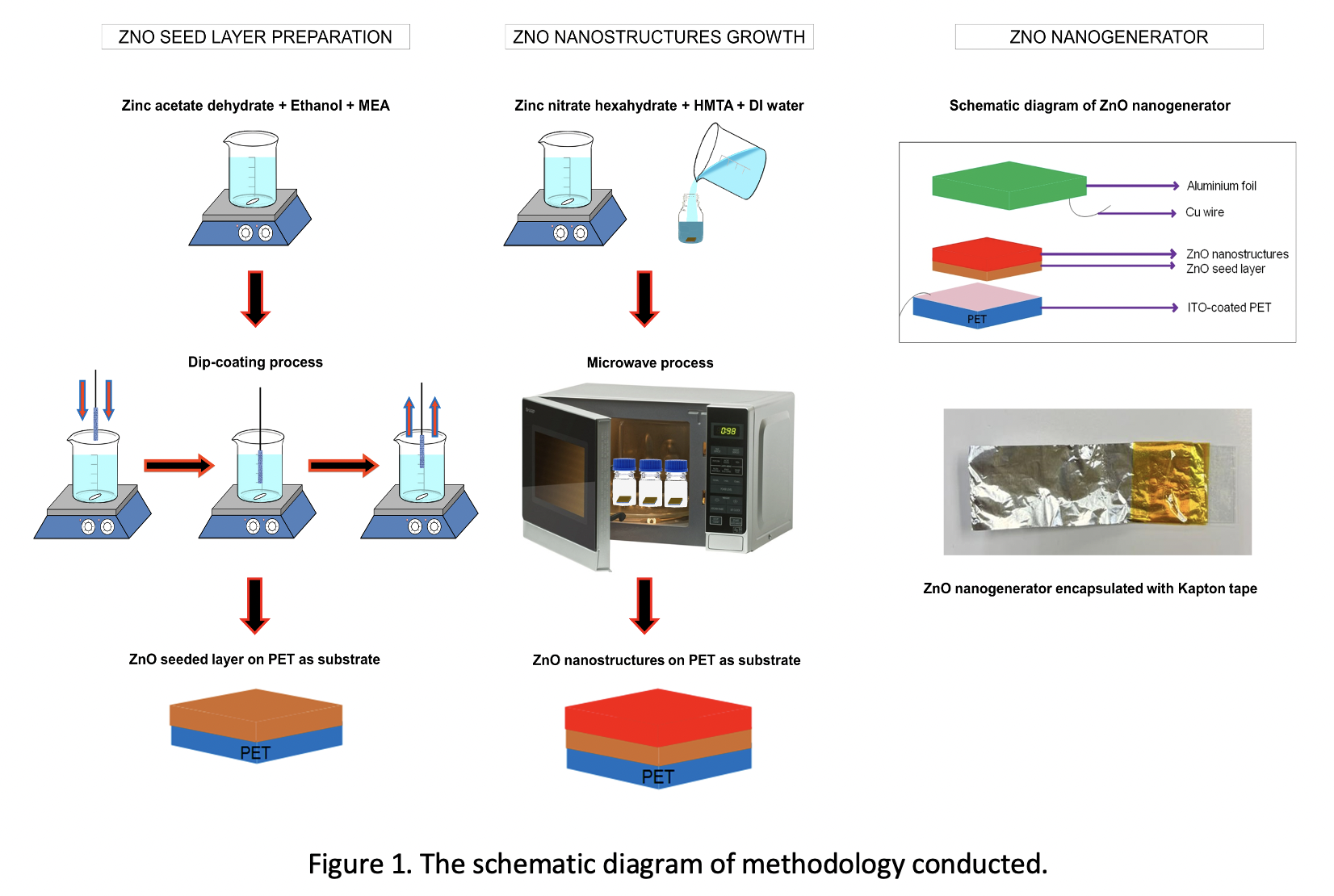
This paper presents an investigation on the influence of deposition time on ZnO-based nanostructures by using microwave-assisted sonochemical technique. Zinc oxide nanostructures (ZnO Ns) were synthesised by preparing the seed layer using ultrasonic-assisted dip-coating technique on both sides of polyethylene terephthalate (PET) as substrate. The ZnO Ns growth was precisely controlled by adjusting the deposition times varying from 30, 60, 90, 120 and 150 minutes. The structural, morphological and optical properties of each sample were characterized by using X-ray Diffraction (XRD), Field Emission Scanning Electron Microscopy (FESEM) and Ultraviolet-Visible (UV-Vis) Spectroscopy. Results revealed that there is an additional peak on XRD analysis that is believed to be the (200) cubic phase ZnO and different structures were also observed for FESEM images as the deposition time varies. Meanwhile, the UV-Vis spectroscopy portrayed a decrease in trend when the deposition time increased from 30 minutes to 150 minutes due to the transmittance of thin films is decreased as film thickness increases. Thus, this work suggested a new approach on the synthesisation of ZnO Ns by using microwave-assisted sonochemical technique which resulted in many potentials for future applications such as nanogenerators, dye-sensitized solar cell (DSSC) and sensors.

Downloads
Download data is not yet available.

Downloads

Published

2026-08-18

How to Cite

Nurfatini Atiqrah Khairul Azhar, Mohd Firdaus Malek, Kevin Alvin Eswar, Maryam Mohammad, Nur Fairuz Rostan, Zahidah Othman, Nurul Zulaikha Mohammad Zamri, Asiah Mohd Nor, Ruziana Mohamed, & Tetsuo Soga. (2026). Influence of Deposition Time on Zno-based Nanostructures by Microwave-assisted Sonochemical Technique. Journal of Advanced Research Design, 147(1), 87–102. Retrieved from http://akademiabaru.com/submit/index.php/ard/article/view/6264
سرور مجازی ایران Decentralized Exchange

Issue

Section

MJIC2025
فروشگاه اینترنتی